


Overview
When developers first encounter LaunchDarkly, they often see it as a feature flag management tool. Turns out calling LaunchDarkly a feature flag tool is like calling a Swiss Army knife “a device for opening wine bottles.” Even though that would still be useful. Although technically true, you’re missing about 90% of the picture. LaunchDarkly has quietly evolved into a full feature delivery platform that happens to use flags as the foundation for four interconnected pillars: Release Management, Observability & Monitoring, and Analytics & Experimentation, and AI Configs. Understanding how these pillars work together, including the backend infrastructure reveals why LaunchDarkly has become mission-critical for modern software delivery.The Foundation: Feature Flag Management
At the heart of LaunchDarkly lies its feature flag management system. Think of feature flags as the control switches for your application’s behavior. But unlike traditional configuration management, LaunchDarkly’s flags are dynamic, real-time, and incredibly sophisticated. Feature flag management serves as the foundation layer because it enables everything else. Without the ability to control feature visibility and behavior at runtime, none of the other pillars could function. This foundation includes:- Feature Flags: Binary or multi-variant toggles that control feature availability.
- AI Configs: Dynamic configuration for AI model parameters and behaviors.
- Targeting Rules: Sophisticated logic for determining who sees what features.
- Context Management: User, device, and organizational context for personalized experiences.
The Four Pillars (Or how to sleep through deployments)

LaunchDarkly Architecture Overview.
**
- Release Management (Yellow)**
**
- Observability & Monitoring (Blue)**
**
- Analytics & Experimentation (Green)**
**
- AI Configs (Purple)**
How the Pillars are Interconnected
The four pillars aren’t just sitting next to each other making awkward small talk. They’re in a deeply committed relationship with constant communication. Here’s how:- Release Management -> Observability: When you toggle a flag or start a rollout, observability tools immediately begin tracking the impact. Error rates, traces, and logs are automatically correlated with the flag change.
- Observability -> Analytics: The data collected through monitoring feeds directly into Experimentation and analytics. You’re not just watching for errors; you’re measuring business impact.
- Analytics -> Release Management: Experiment results inform which variations to roll out. Metrics from guarded rollouts trigger automatic decisions (rollback or continue).
- AI Configs -> All Pillars: AI configurations add a dynamic layer across the ecosystem:
- To Release Management: Model versions, prompts, and parameters can be toggled like features, enabling safe AI deployments.
- To Observability: Track model performance, latency, token usage, and output quality in real-time.
- To Analytics: A/B test different prompts, models, or parameters to optimize AI outcomes and measure business impact.
- Feature Flags Enable Everything: Without the foundational flag management system, none of these capabilities would work. Flags are the control point that makes progressive delivery, real-time monitoring, and controlled Experimentation possible.
The Infrastructure: Flag Delivery Network (FDN)
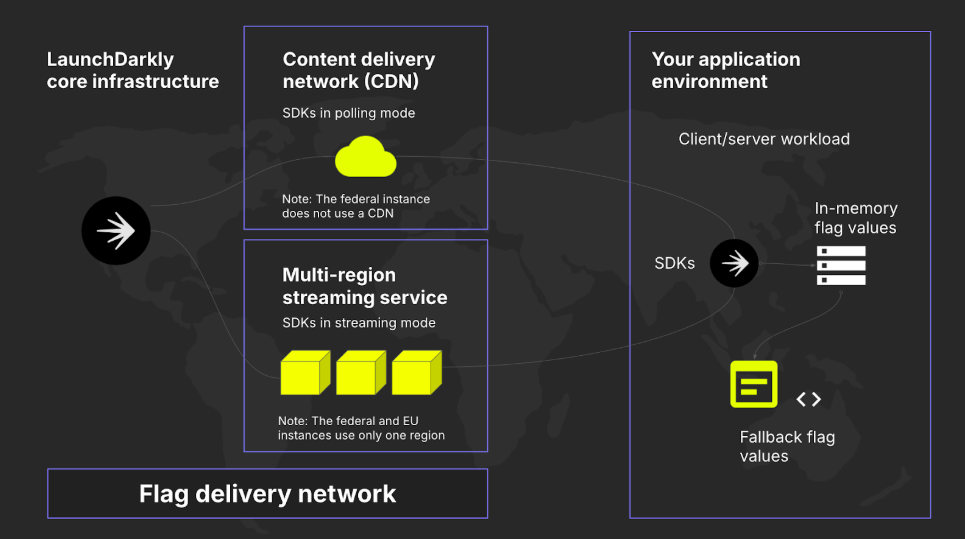
Image of Flag Delivery Network Infrastructure.
What is the FDN?
The Flag Delivery Network is LaunchDarkly’s proprietary infrastructure combining:- LaunchDarkly’s core infrastructure: Central flag management and rule evaluation engine.
- Content Delivery Network (CDN): Over 100 points of presence globally.
- Multi-region streaming service: Real-time flag updates via persistent connections.
How the FDN Works
- Flag Creation: A developer, PM, or operator creates or modifies a flag in the LaunchDarkly dashboard.
- Global Distribution: The flag configuration is immediately pushed to all CDN edge locations worldwide.
- SDK Connection: Your application’s LaunchDarkly SDK connects to the nearest CDN point of presence.
- Initial Load: The SDK retrieves all flag configurations and stores them in memory.
- Real-time Updates: The SDK maintains a streaming connection; when flags change, updates arrive in milliseconds.
- Local Evaluation: Flag rules are evaluated locally in your application, which means no round-trip to LaunchDarkly required for each flag check.
SDK Modes: Polling vs. Streaming
LaunchDarkly SDKs can operate in two modes: streaming mode or polling mode. Streaming Mode (recommended for server-side SDKs):- Maintains a persistent connection to the FDN.
- Receives flag updates in real-time.
- Ideal for long-running applications like backend services.
- Periodically checks for flag updates.
- Lower resource usage on mobile devices.
- Configurable polling interval.
The Six Layers of Resilience
LaunchDarkly’s architecture includes multiple layers of failover to ensure flags are always available:- In-memory cache: SDKs store flags locally; if the network fails, your app continues working.
- Fallback values: Every flag evaluation includes a default fallback value.
- CDN redundancy: 100+ global Points of Presence (POPs) ensure low latency and high availability.
- Multi-region infrastructure: LaunchDarkly’s core systems span multiple cloud regions.
- SDK resilience: Automatic retry logic and circuit breakers.
- Relay Proxy option: Deploy your own local flag cache for maximum control.
Putting It All Together: A Real-World Scenario
Let me walk you through how this actually works in practice. Picture this: your team wants to launch a new checkout flow. In the old days (2023), this would involve:- Extensive staging testing.
- A carefully planned deployment window.
- Someone’s weekend.
- Hoping for the best.
- Create feature flag new-checkout-flow.
- Configure AI configs for the personalized product recommendation model (prompt version, temperature, model selection).
- Configure targeting rules (start with your internal test accounts, because you’re not a monster).
- Start a guarded rollout to 10% of production traffic.
- Flag configuration and AI Config hit the FDN globally (this happens in milliseconds, which is faster than you can say “Jenkins pipeline”).
- Your mobile and web SDKs receive the update via their streaming connections.
- Flags are evaluated locally in-memory, adding exactly zero latency to your checkout flow.
- Session replay starts capturing user interactions with the new flow.
- Traces show checkout API performance in real-time.
- Error monitoring tracks any exceptions (there will be exceptions, there are always exceptions).
- Dashboards update with adoption metrics and AI performance indicators.
- Everything comes back as green.
- Metrics automatically track conversion rate, cart abandonment, purchase value.
- AI-specific metrics measure recommendation click-through rates and relevance scores.
- Guarded rollout monitors for regressions (error rate, latency, AI hallucinations, angry user emails).
- A/B test different prompt variations or model parameters to optimize recommendations.
- If metrics look good: automatic progression to 25% -> 50% -> 100%.
- If metrics look bad: automatic rollback before your on-call engineer finishes their coffee.
- You receive a Slack notification.
- Feature safely released with automated safeguards.
- AI models deployed and optimized without risking production.
- Full visibility into user experience and system health.
- Data-driven decision on whether to keep the feature and which AI configuration performs best.
- Zero code deploys after the initial setup.
- You solved this entire problem without leaving your hammock.
Why This Architecture Matters
LaunchDarkly’s architecture represents a fundamental shift in how we think about software delivery: Traditional Approach: Deploy -> Hope -> React to incidents -> Debug -> Fix -> Deploy again. LaunchDarkly Approach: Deploy once -> Control via flags -> Monitor continuously -> Experiment safely -> Optimize based on data. The key innovation is making the feature flag the control point for delivery, observability, Experimentation and AI Configs. This creates a closed feedback loop:- Release Management provides the controls (the steering wheel).
- Observability provides the visibility (the headlights and dashboard).
- Analytics provides the insights (the GPS telling you which route is actually faster).
- AI Configs provide the intelligence (the adaptive cruise control that adjusts based on conditions).
- Feature flags tie it all together (they’re the guardrails, ensuring the car stays on the road).